

Full Automatic Solar Simulator IV Characterization System
- Product Code: Full-Automatic-Solar-Simulator-IV-Characterization-System
- Availability: In Stock
 Full Automatic Solar Simulator IV Characterization System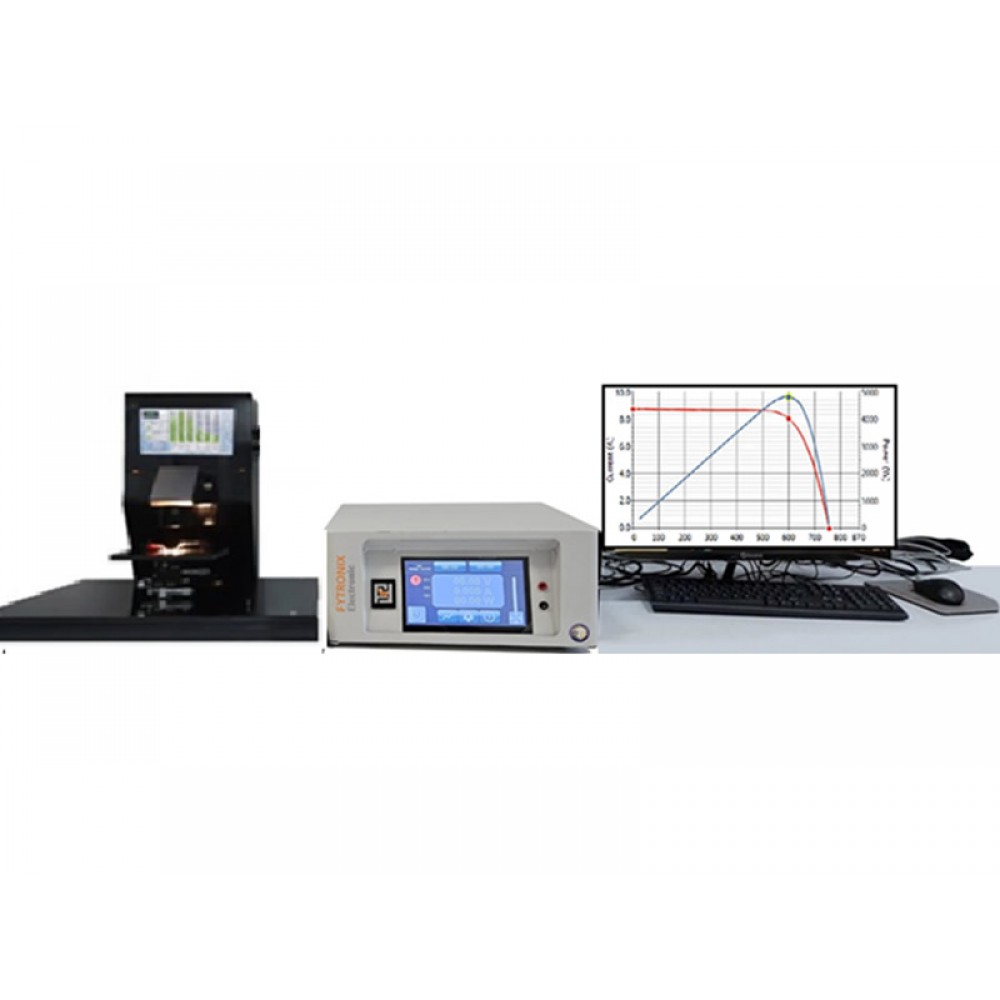
Full Automatic Solar Simulator IV Characterization System
SM-9000
The SM-9000 is a fully automatic AAA-class solar simulator IV characterization system designed for high-precision I–V, P–V, and photovoltaic mechanism analysis of all types of solar cells. The system provides computer-controlled operation, automatic light intensity adjustment, and fully automated measurement of key photovoltaic parameters under variable illumination conditions.
LSS Solar Simulator IV Characterization System
Spectral Solar Irradiance Matching – AAA Class
System Overview
The LSS Solar Simulator IV Characterization System is a complete photovoltaic characterization platform for advanced laboratory and research applications. Designed for accurate and repeatable measurement of I–V, I-t, and P–V characteristics, it supports a wide range of solar cell technologies including:
• Dye-Sensitized Solar Cells (DSSC)
• Quantum Dot Solar Cells (QDSC)
• Organic Solar Cells (OSC)
• Perovskite Solar Cells
• Silicon Solar Cells
• Thin-Film Solar Cells
The system operates under adjustable solar light intensities from 0.1 W/cm² to 1500 W/m², providing a fully controlled environment for current-voltage, current-time, and power-voltage measurements.
________________________________________
System Components
1. AAA Class Solar Simulator – Maintenance-free, high stability, factory-calibrated for AM1.5G spectral match
2. Precision Sourcemeter – Voltage range: -7 V to +7 V, Current range: 10 nA to 30 mA
3. Solar Light Controller – Ensures precise and stable irradiance output
4. Automatic IV Measurement Controller – For programmable measurement sequences
5. Calibrated Reference Solar Cell – Factory calibrated for intensity and spectral match
6. Sample Holder – Adjustable for multiple orientations, including 0°–90° rotation
7. Software Suite
________________________________________
Software Suite
The system includes multiple software modules for complete photovoltaic analysis:
• Solar IV Characterization Software – Automated I–V and P–V measurements
• Solar Life-Time Software – Long-term solar cell stability analysis
• Transient Photocurrent Software – Time-resolved photocurrent measurements (I-t)
• Photovoltaic Mechanism Analysis Software – Detailed analysis of PV mechanisms
________________________________________
Key Features
• Universal Solar Cell Compatibility: DSSC, QDSC, OSC, Perovskite, Silicon, Thin-Film
• Irradiance Range: 0.1 W/cm² to 1500 W/m²
• Illumination Area: 2” x 2” at 1 Sun
• PV Cell Placement Indicator: Ensures precise alignment
• Adjustable Orientation: Can be mounted pointing up, down, or sideways with 90° rotational accessory
• Temperature-Controlled Simulator: Stable output under varying laboratory conditions
• USB Communication: Easy interface with control software
• Standards Compliance: Class AAA for IEC 60904-9, JIS C 8912, and ASTM E 927
• Easy Light Adjustment: Fine-tune solar intensity with the controller
________________________________________
Electrical & Measurement Specifications
• Voltage Range: -7 V to +7 V
• Current Range: 10 nA to 30 mA
• Measurement Capabilities:
o I–V (Current-Voltage)
o I-t (Current-Time / Transient Photocurrent)
o P–V (Power-Voltage)
• Calibration: Factory-calibrated reference solar cell for AM1.5G spectral match and irradiance intensity
________________________________________
Applications
• Research & development of advanced solar cells
• Photovoltaic device quality control
• Laboratory teaching & experiments
• Stability and lifetime studies of solar cells
• Comparative studies of emerging photovoltaic technologies
________________________________________
LSS Automatic Solar IV Characterization System
Class AAA Solar Simulator – High-Precision Photovoltaic Characterization
________________________________________
System Overview
The LSS Solar Simulator System generates a continuous AAA-class light spectrum for precise characterization of all types of solar cells. The system is capable of illuminating devices up to 25 × 25 mm or larger, with adjustable light intensity ranging from 1 W/m² to 1000 W/m².
The solar simulator and I–V measurement system are fully computer-controlled, enabling automated measurement, analysis, and reporting of photovoltaic parameters and mechanisms.
________________________________________
Key Measurement Capabilities
I–V Characterization
• Dark and illuminated I–V measurements for analysis of series resistance, shunt resistance, diode factor, and saturation currents
• Light I–V measurements for standard photovoltaic characterization
Power-Voltage (P–V) Measurement
• Simultaneous acquisition of current-voltage and power-voltage curves under variable illumination
Photovoltaic Mechanism Analysis
• Automatic determination of mechanisms including monomolecular recombination, supra-linear mechanisms, etc.
• Real-time identification of the dominant mechanism on the computer screen
________________________________________
Photovoltaic Parameters Measured Automatically
• Open Circuit Voltage (Voc)
• Short Circuit Current (Isc)
• Maximum Power Output (Pmax)
• Voltage at Pmax (Vmax)
• Current at Pmax (Imax)
• Fill Factor (FF)
• Series Resistance (Rs)
• Shunt Resistance (Rsh)
• Characteristic Resistance of Solar Cell (Rch)
• Photoresponse (RR)
• Conversion Efficiency (η)
________________________________________
System Automation Features
• Computer-controlled automatic solar simulator
• Automatic intensity adjustment from 0.1 W/cm² to 1000 W/cm² with 1 mW/cm² steps
• Automatic measurement of:
o I–V curves
o P–V curves
o I–sc vs. solar light intensity
o Photovoltaic mechanism analysis
• Automatic data analysis and real-time display of mechanism type
Technical Specifications
Feature Specification
Solar Simulator Control Fully computer-controlled
Light Intensity Range 0.1 W/cm² – 1000 W/cm², adjustable in 1 mW/cm² steps
Measurement Modes I–V, P–V, Isc-Light Intensity, Photovoltaic mechanism analysis
Source Meter Voltage: -7 V to +7 VCurrent: 1 nA – 30 mA (or higher)
Automatic Shuttering Light intensity automatically adjusted 1–1000 W/m²
Software Complete measurement, data acquisition, and analysis
Sample Size Up to 25 × 25 mm
Installation & Training Included
________________________________________
Applications
• Laboratory-scale photovoltaic research and development
• Characterization of Dye-Sensitized, Quantum Dot, Organic, Perovskite, Silicon, and Thin-Film Solar Cells
• Long-term stability and lifetime testing
• Advanced photovoltaic mechanism studies
________________________________________
System Highlights
• AAA-class spectrum for accurate AM1.5G simulation
• Continuous light spectrum with adjustable irradiance
• Fully automated I–V and P–V measurements
• Automatic photovoltaic mechanism identification
• User-friendly software interface for real-time analysis
• Suitable for research labs, universities, and industrial R&D
________________________________________
System Software
The LSS Solar Simulator System is equipped with two advanced software modules for complete photovoltaic characterization:
________________________________________
1. Photovoltaic Parameter Characterization Software
This software automates the measurement and calculation of all key photovoltaic parameters of solar cells. The system performs measurements and determines the following parameters:
• Short Circuit Current (Isc)
• Open Circuit Voltage (Voc)
• Maximum Power (Pmax)
• Current at Maximum Power (Imax)
• Voltage at Maximum Power (Vmax)
• Conversion Efficiency (η)
• Shunt Resistance (Rsh)
• Series Resistance (Rs)
The software provides real-time plotting, data acquisition, and export functions for laboratory and research applications.
________________________________________
2. Photovoltaic Mechanism Analysis Software
This software module automatically analyzes the photovoltaic mechanisms of the solar cell under test. It can identify dominant mechanisms such as:
• Monomolecular recombination
• Supra-linear recombination
• Other device-specific recombination processes
Results are displayed directly on the computer interface, enabling fast, automated analysis and mechanism classification without manual intervention.


