

QUANTUMSOL AXON
- Product Code: Quantumsol-Axon-Solar-Simulator-IV-and-CV
- Availability: In Stock
 QUANTUMSOL AXON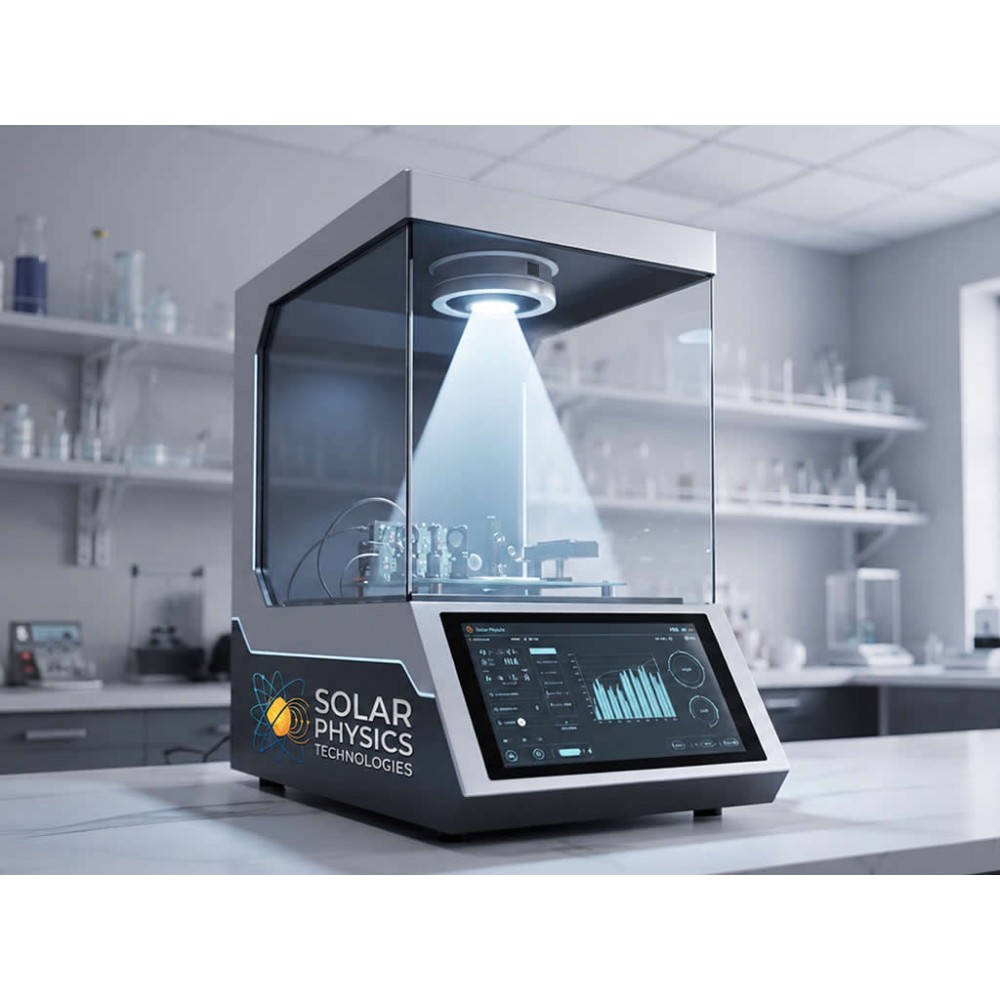
QUANTUMSOL AXON
Full Automatic Solar Simulator
IV and CV System
The QUANTUMSOL AXON is a fully automatic AAA-class solar simulator IV and Impedance characterization system designed for high-precision I–V, P–V, and photovoltaic mechanism analysis of all types of solar cells. The system provides computer-controlled operation, automatic light intensity adjustment, and fully automated measurement of key photovoltaic parameters under variable illumination conditions.
Solar Simulator IV Characterization System
Spectral Solar Irradiance Matching – AAA Class
System Overview
The LSS Solar Simulator IV Characterization System is a complete photovoltaic characterization platform for advanced laboratory and research applications. Designed for accurate and repeatable measurement of I–V, I-t, and P–V characteristics, it supports a wide range of solar cell technologies including:
• Dye-Sensitized Solar Cells (DSSC)
• Quantum Dot Solar Cells (QDSC)
• Organic Solar Cells (OSC)
• Perovskite Solar Cells
• Silicon Solar Cells
• Thin-Film Solar Cells
The system operates under adjustable solar light intensities from 0.1 W/cm² to 1500 W/m², providing a fully controlled environment for current-voltage, current-time, and power-voltage measurements.
System Includes
1. AAA Class Solar Simulator – Maintenance-free, high stability, factory-calibrated for AM1.5G spectral match
2. Precision Sourcemeter – Voltage range: -9 V to +9 V, Current range: 1 nA to 30 mA
3. Solar Light Controller – Ensures precise and stable irradiance output
4. Automatic IV Measurement Controller – For programmable measurement sequences
5. Calibrated Reference Solar Cell – Factory calibrated for intensity and spectral match
6. Sample Holder – Adjustable for multiple orientations, including 0°–90° rotation
7. Software Suite
Software Suite
The system includes multiple software modules for complete photovoltaic analysis:
• Solar IV Characterization Software – Automated I–V and P–V measurements
• Solar Life-Time Software – Long-term solar cell stability analysis
• Transient Photocurrent Software – Time-resolved photocurrent measurements (I-t)
• Photovoltaic Mechanism Analysis Software – Detailed analysis of PV mechanisms
Key Features
• Universal Solar Cell Compatibility: DSSC, QDSC, OSC, Perovskite, Silicon, Thin-Film
• Irradiance Range: 0.1 W/cm² to 1500 W/m²
• Illumination Area: 2” x 2” at 1 Sun
• PV Cell Placement Indicator: Ensures precise alignment
• Adjustable Orientation: Can be mounted pointing up, down, or sideways with 90° rotational accessory
• Temperature-Controlled Simulator: Stable output under varying laboratory conditions
• USB Communication: Easy interface with control software
• Standards Compliance: Class AAA for IEC 60904-9, JIS C 8912, and ASTM E 927
• Easy Light Adjustment: Fine-tune solar intensity with the controller
________________________________________
Electrical & Measurement Specifications
Sourcemeter
• Voltage Range: -9 V to +9 V
• Current Range: 1 nA to 30 mA
• Measurement Capabilities:
o I–V (Current-Voltage)
o I-t (Current-Time / Transient Photocurrent)
o P–V (Power-Voltage)
• Calibration: Factory-calibrated reference solar cell for AM1.5G spectral match and irradiance intensity
Impedance analyzer
Advanced C-V & Semiconductor Analysis
• Capacitance-Voltage (C-V): Characterize doping profiles and threshold voltages for diodes, photodiodes, and solar cells
•
• Measurement Modes: Supports Amplitude, Constant Voltage, and Constant Current sweeps.
Comprehensive Parameter Measurement
The system simultaneously measures and analyzes parameters in both Series and Parallel modes:
• Impedance (Z): Magnitude |Z|, Phase Angle theta, Series/Parallel Resistance (Rs, Rp), and Reactance (Xs, Xp).
•
• Admittance (Y): Magnitude |Y|, Conductance (Gs, Gp), and Susceptance (Bs, Bp).
• Capacitance & Inductance: Cs, Cp, Ls, Lp.
• Loss Factors: Dissipation factor (D or tan) and Quality factor (Q)
Nyquist Measurements
Bode Measurements
Wide Frequency Dynamics
• Frequency Range: 1mHz to 25 MHz
• EIS vs. Frequency: Real-time measurement of real and imaginary forms of impedance, conductance, and capacitance.
Votlage range: -5 V to 5 V adjustable
Applications
• Research & development of advanced solar cells
• Photovoltaic device quality control
• Laboratory teaching & experiments
• Stability and lifetime studies of solar cells
• Comparative studies of emerging photovoltaic technologies
Automatic Solar IV Characterization System
Class AAA Solar Simulator – High-Precision Photovoltaic Characterization
System Overview
The Solar Simulator System generates a continuous AAA-class light spectrum for precise characterization of all types of solar cells. The system is capable of illuminating devices up to 50 × 50 mm or larger, with adjustable light intensity ranging from 1 W/m² to 1000 W/m².
The solar simulator and I–V measurement system are fully computer-controlled, enabling automated measurement, analysis, and reporting of photovoltaic parameters and mechanisms.
Key Measurement Capabilities
I–V Characterization
• Dark and illuminated I–V measurements for analysis of series resistance, shunt resistance, diode factor, and saturation currents
• Light I–V measurements for standard photovoltaic characterization
Power-Voltage (P–V) Measurement
• Simultaneous acquisition of current-voltage and power-voltage curves under variable illumination
Photovoltaic Mechanism Analysis
• Automatic determination of mechanisms including monomolecular recombination, supra-linear mechanisms, etc.
• Real-time identification of the dominant mechanism on the computer screen
Photovoltaic Parameters Measured Automatically
• Open Circuit Voltage (Voc)
• Short Circuit Current (Isc)
• Maximum Power Output (Pmax)
• Voltage at Pmax (Vmax)
• Current at Pmax (Imax)
• Fill Factor (FF)
• Series Resistance (Rs)
• Shunt Resistance (Rsh)
• Characteristic Resistance of Solar Cell (Rch)
• Photoresponse (RR)
• Conversion Efficiency (η)
System Automation Features
• Computer-controlled automatic solar simulator
• Automatic intensity adjustment from 0.1 W/cm² to 1000 W/cm² with 1 mW/cm² steps
• Automatic measurement of:
o I–V curves
o P–V curves
o I–sc vs. solar light intensity
o Photovoltaic mechanism analysis
• Automatic data analysis and real-time display of mechanism type
Technical Specifications
Feature Specification
Solar Simulator Control Fully computer-controlled
Light Intensity Range 0.1 W/cm² – 1000 W/cm², adjustable in 1 mW/cm² steps
Measurement Modes I–V, P–V, Isc-Light Intensity, Photovoltaic mechanism analysis
Source Meter Voltage: -9 V to +9 VCurrent: 1 nA – 30 mA (or higher)
Automatic Shuttering Light intensity automatically adjusted 1–1000 W/m²
Software Complete measurement, data acquisition, and analysis
Sample Size Up to 50 × 50 mm
Installation & Training Included
________________________________________
Applications
• Laboratory-scale photovoltaic research and development
• Characterization of Dye-Sensitized, Quantum Dot, Organic, Perovskite, Silicon, and Thin-Film Solar Cells
• Long-term stability and lifetime testing
• Advanced photovoltaic mechanism studies
System Highlights
• AAA-class spectrum for accurate AM1.5G simulation
• Continuous light spectrum with adjustable irradiance
• Fully automated I–V and P–V measurements
• Automatic photovoltaic mechanism identification
• User-friendly software interface for real-time analysis
• Suitable for research labs, universities, and industrial R&D
System Software
The Solar Simulator System is equipped with two advanced software modules for complete photovoltaic characterization:
1. Photovoltaic Parameter Characterization Software
This software automates the measurement and calculation of all key photovoltaic parameters of solar cells. The system performs measurements and determines the following parameters:
• Short Circuit Current (Isc)
• Open Circuit Voltage (Voc)
• Maximum Power (Pmax)
• Current at Maximum Power (Imax)
• Voltage at Maximum Power (Vmax)
• Conversion Efficiency (η)
• Shunt Resistance (Rsh)
• Series Resistance (Rs)
The software provides real-time plotting, data acquisition, and export functions for laboratory and research applications.
2. Photovoltaic Mechanism Analysis Software
This software module automatically analyzes the photovoltaic mechanisms of the solar cell under test. It can identify dominant mechanisms such as:
• Monomolecular recombination
• Supra-linear recombination
• Other device-specific recombination processes
Results are displayed directly on the computer interface, enabling fast, automated analysis and mechanism classification without manual intervention.
3. Impedance analyzer Measurements
Advanced C-V & Semiconductor Analysis
• Capacitance-Voltage (C-V): Characterize doping profiles and threshold voltages for diodes, photodiodes, and solar cells
• Measurement Modes: Supports Amplitude, Constant Voltage, and Constant Current sweeps.
Comprehensive Parameter Measurement
The system simultaneously measures and analyzes parameters in both Series and Parallel modes:
• Impedance (Z): Magnitude |Z|, Phase Angle theta, Series/Parallel Resistance (Rs, Rp), and Reactance (Xs, Xp)
• Admittance (Y): Magnitude |Y|, Conductance (Gs, Gp), and Susceptance (Bs, Bp).
• Capacitance & Inductance: Cs, Cp, Ls, Lp.
• Loss Factors: Dissipation factor (D or tan) and Quality factor (Q)
Nyquist Measurements
Bode Measurements
Wide Frequency Dynamics
• Frequency Range: 1mHz to 25 MHz
• EIS vs. Frequency: Real-time measurement of real and imaginary forms of impedance, conductance, and capacitance.


